
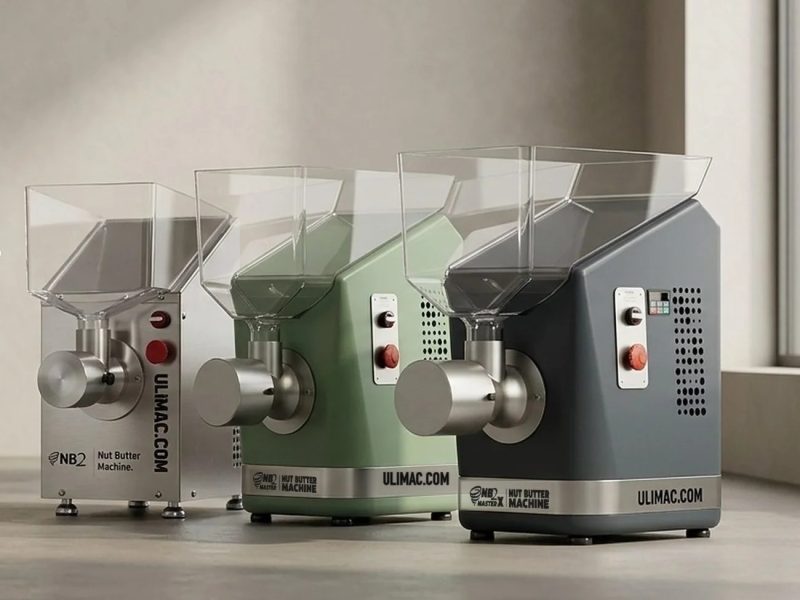
A commercial nut butter grinder turns roasted nuts into fresh nut butter in a few minutes, with nothing added. Shops sell it fresh in front of their customers, cafés and gelato labs make their own pastes, and small brands fill their own jars. We build these machines in Ankara and ship them worldwide. This guide shows how to choose the right one.
- Peanut and hazelnut butter in the kitchen or behind the counter: NB2, about 65–75 kg per hour on a normal socket.
- Retail counters, self-service, almond and pistachio butter, or long production runs: NB2 Master on 380 V three phase. Choose Master X where three-phase electricity is not available.
- Your power supply decides the version: 220–240 V single phase, 380 V three phase, or 110–120 V / 60 Hz.
How a nut butter grinder works
Roasted nuts go from the hopper into the grinding chamber. There they are crushed between grinding plates, release their own oil and come out of the spout as a paste.
The gap between the plates sets the texture. A small gap gives smooth butter, a wider gap gives crunchy butter, and you set it yourself. Grinding warms the paste a little, which helps the oil flow.
The four types of grinder
Very different machines are sold under the same name. They fall into four groups:
Small table grinder
about 10–15 kg/h
Around 1 kW. Good for testing a recipe, not for selling every day.
Commercial disc grinder
about 65–75 kg/h
Peanut and hazelnut butter made in the kitchen or behind the counter, using a normal socket. Our model: NB2.
Heavy-duty grinder
about 70–120 kg/h
For retail counters, self-service, hard nuts and long runs, we recommend NB2 Master. Choose Master X where three-phase electricity is not available.
Colloid mill or line
hundreds of kg/h
For industrial plants with three-phase power, a filling line and staff.
Shops, cafés and small brands need one of the two middle groups. The rest of this guide is about choosing between them.
Start with the nut
Peanuts and hazelnuts
Well roasted, they release their oil fast and turn smooth quickly. NB2 handles them in the kitchen or behind the counter. For retail counters and self-service, choose Master, or Master X where three-phase electricity is not available.
Almonds and pistachios
They are harder and give up their oil slowly. They need more torque, so a heavy-duty grinder is the right choice.
Always grind roasted nuts. Roasting lowers moisture and opens the nut, so the oil comes out and the butter flows. All capacities in this guide are for roasted nuts. We explain why in roasted nuts and fat content.
Size it by your busy day
Capacity is given in kilograms per hour. For a shop it is easier to count jars. Take a busy day with 100 jars of 250 g:
NB2 can prepare peanut and hazelnut butter in batches behind the counter. For customer-facing retail and self-service, we recommend Master, even when you fill only a few jars at a time. Master is also our recommendation for continuous, intensive production; choose Master X where three-phase electricity is not available. These are our approximate capacities with roasted nuts:
How much nut butter in one hour
Roasted nuts, kg per hour.
Approximate values. Capacity depends on roasting and on the texture you set.
You can watch NB2 grinding peanut, pistachio and almond butter in the videos on its product page.
Match your power supply
A three-phase machine does not run on a wall socket, and a 50 Hz machine is wrong for a 60 Hz country. Pick the version for your building:
NB2 Master X runs on single-phase 220 V through a built-in drive and lets you adjust speed and torque, which helps with hard nuts.
Self-serve or behind the counter
For customer-facing counters and self-service in zero-waste shops, organic stores and cafés, we recommend NB2 Master. Where three-phase electricity is not available, choose Master X. Both have a composite shell that absorbs noise and vibration.
For peanut and hazelnut butter made in the kitchen or behind the counter, NB2 runs on a normal socket. For continuous, intensive production, choose Master, or Master X where three-phase electricity is not available.
Materials, noise and cleaning
- NB2 is fully stainless steel, body and parts.
- NB2 Master and Master X have a composite shell that absorbs noise and vibration. Every part that touches the food is stainless steel.
- Clean the grinding parts at the end of each day and when you switch to another nut, to keep flavours and allergens apart.
Every machine comes with a 2-year warranty and CE certification, and ships in 1–3 business days by DHL or FedEx. As the manufacturer, we supply spare parts and support directly.
Which model fits you
Frequently asked questions
Can one machine grind both peanuts and almonds?
Yes. Choose NB2 Master for both, or Master X where three-phase electricity is not available. Master and Master X make about 70 kg of almond butter per hour. NB2 is our option for peanut and hazelnut production in the kitchen or behind the counter.
Do I need to add oil?
No. Well-roasted nuts release enough of their own oil. You add nothing unless your recipe asks for it.
Is a nut butter grinder loud?
Every grinder makes some noise. The composite shell on NB2 Master and Master X absorbs noise and vibration. For retail counters and self-service, we recommend Master, or Master X where three-phase electricity is not available.
Tell us your nuts and your power supply
We will recommend the right model and send you a quote with shipping, the same working day.